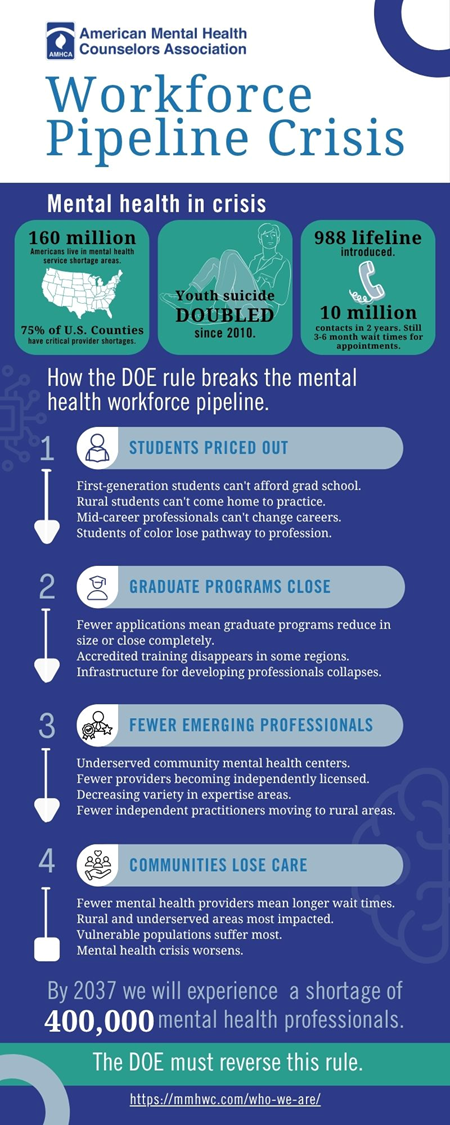
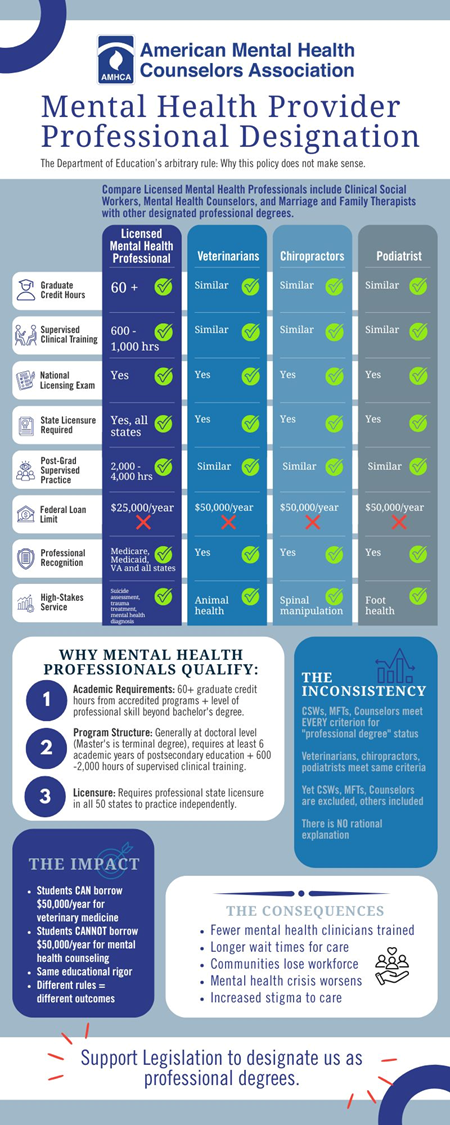
I write this today with frustration in the results of this final rule from the Department of Education. AMHCA strongly opposes the U.S. Department of Education’s decision to exclude master’s-level Mental Health Counseling programs from professional degree status in the final Reimagining and Improving Student Education (RISE) rule. As stated in our public comment, this arbitrary classification represents a policy failure that will directly harm millions of Americans struggling with mental health conditions through our career pipeline.
I had commented yesterday on the discussion thread about the final rule from the Department of Education. See the announcement for more information. The final rule with public comment and response from the DOE was made available yesterday and published today. The DOE grouped public comment by theme and topic and narrowed over 80,000 comments to 276 topic areas. Out of 276 topic areas, there were 21 changes made. Six of those changes were technical in nature (adjusting spelling, formatting, or wording change) and another 6 were changes made to clarify a point, not change the nature of that part of the ruling.
Future action in line with our Public Policy and Legislative Committee:
We will continue to use our "Call to Action" page ( Call to Action - American Mental Health Counselors Association) to communicate what action steps we are taking and encourage our members and interested supporters to take part in this work. We are supporting the LEAP act currently and working with our coalitions to ensure the bills in Congress would rectify this issue for mental health providers. The Loan Equity for Advance Professionals (LEAP) Act (H.R. 6574) would establish uniform borrowing limits for all graduate and professional students and is on our call to action page. The Professional Student Degree Act (H.R. 6718) is a bipartisan bill that would add social work to the list of degrees considered professional and includes clinical psychology and social work, but does not explicitly list mental health counseling programs or marriage and family therapy programs. The Professional Degree Access Restoration Act (S. 4039/H.R. 6677) would reverse the student loan restrictions and reinstate the Grad PLUS loan program and could be a solution. We will also continue to meet with legislators, work through coalitions, and continue with our media campaigns (see our call to action page).
Response to AMHCA's Public Comment:
We urged the department in our public comment to do the following:
- Classify the master’s and doctoral programs in mental health and substance use necessary to obtain licensure as a Licensed Clinical Social Worker, Licensed Marriage and Family Therapist, or Licensed Professional Clinical Counselor in the category of “professional degree;"
- Align federal loan policy with the realities of licensure, scopes of practice, and regulatory practices for these professionals; and
- Retain income-contingent repayment options to preserve access to education and sustain the mental health and substance use workforce.
Regarding our first request, the Department did not incorporate this recommendation. While the Department noted that its definition of “professional degree” is not intended as a judgment of a profession’s value, this distinction has meaningful implications for how these programs are financed and perceived. Mental and behavioral health professionals are licensed, regulated providers delivering essential healthcare services, and their classification within federal policy should reflect this reality.
The Department also introduced additional data tables (Tables 1–6) within the Regulatory Impact Analysis. Notably, Table 2 demonstrates that master’s-level programs in social work, mental health counseling, and counseling psychology are not only high-borrowing fields, but fields in which a significant number of students exceed new federal loan limits. This highlights a structural mismatch between the cost of required training and available federal financing. As a result, these programs are likely to be disproportionately impacted by the rule, with potential downstream effects on enrollment and, ultimately, the behavioral health workforce pipeline.
Regarding our second request, the Department acknowledged concerns raised by stakeholders about licensure-based professions but did not make substantive changes to address them. The final rule maintains a standardized, earnings-based framework and explicitly declines to tailor accountability measures to professions with distinct licensure pathways and regulatory structures.
This approach fails to account for the realities of mental health professions, where:
- Earnings are influenced by reimbursement rates set by public programs such as Medicare and Medicaid;
- Full earning potential is often delayed due to required post-graduate supervision and licensure processes; and
- Career pathways are closely tied to public service and community-based care settings.
By prioritizing a uniform earnings metric, the rule does not reflect the economic and regulatory structure of these professions and does not address the underlying drivers of educational cost or workforce need.
Regarding our third request, the Department made no changes to retain income-contingent repayment options. While acknowledging concerns about affordability, the Department finalized a shift toward a simplified repayment system, replacing existing income-driven repayment options with a more limited Repayment Assistance Plan.
The phase-out and eventual removal of income-contingent repayment reduces flexibility that has historically supported access to graduate education in lower-paying, high-need fields such as mental and behavioral health. This change is likely to create additional financial barriers for prospective students and may discourage entry into professions that are critical to addressing the nation’s mental health needs.
Taken together, these decisions create a policy framework that risks restricting access to education for future mental health professionals at a time of significant and well-documented workforce shortages. The Mental Health Workforce Student Loan Affordability Coalition urges congress to take action to ensure that federal student loan policy supports, rather than undermines, the mental health and substance use workforce. We ask Congress to recognize graduate programs required for licensure in professions such as clinical mental health counseling, social work, and marriage and family therapy as professional degree programs; to align loan policies with the realities of licensure pathways, including delayed earnings and regulatory requirements; and to preserve or restore flexible, income-driven repayment options that make graduate education accessible for those entering essential, lower-paying public service careers.